Anchor
A state-aware interaction system that adapts interface complexity in real time during moments of cognitive overload.
The idea
Most interfaces assume you show up ready. Anchor doesn't.
A state-aware interaction system that reads cognitive load in the moment and adjusts what it asks of you.
Users don't need more advice. They need help acting differently in the moment.
Users don't need more advice. They need help acting differently in the moment.
The approach
01 — Interrupt before insight
Break the loop before analyzing it.
02 — Low cognitive load
Fewer decisions, always a clear next step.
03 — State-specific response
Each pattern gets its own strategy.
Break the loop before analyzing it.
02 — Low cognitive load
Fewer decisions, always a clear next step.
03 — State-specific response
Each pattern gets its own strategy.
The system
Entry →
Single tap, no diagnosis needed
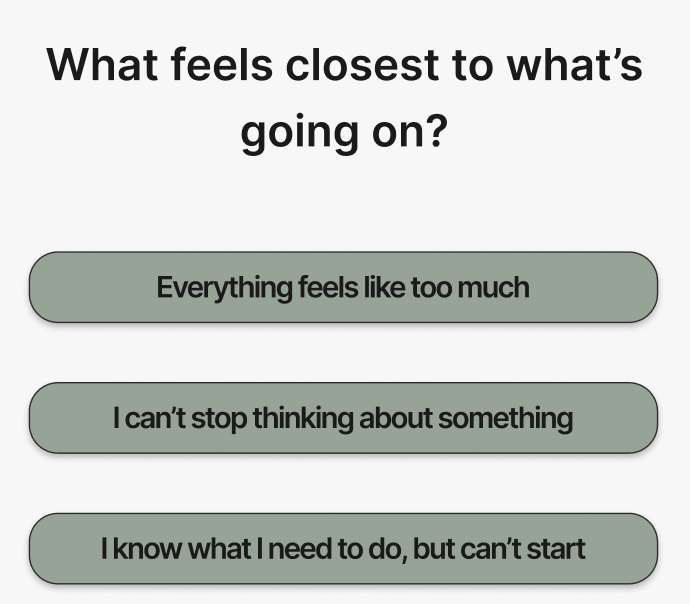
Adaptive Path →
Interaction depth adjusts to cognitive state
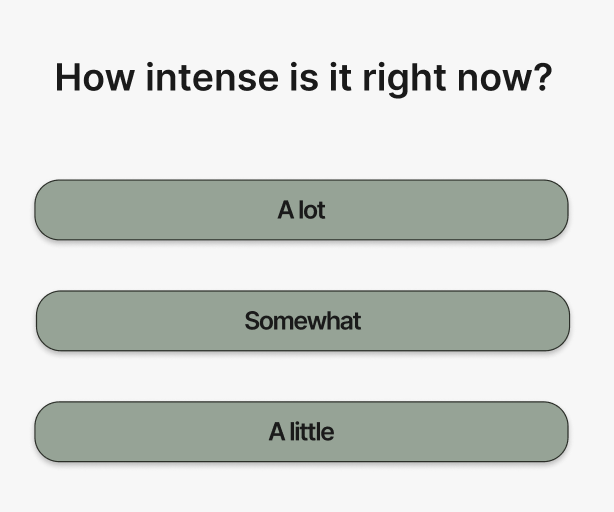
Stabilization →
Sequenced decisions reduce overload
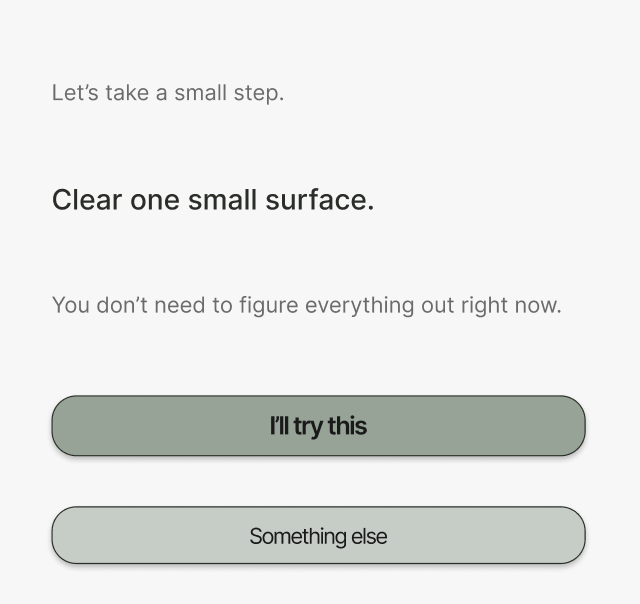
Reflection
Introduced after regulation
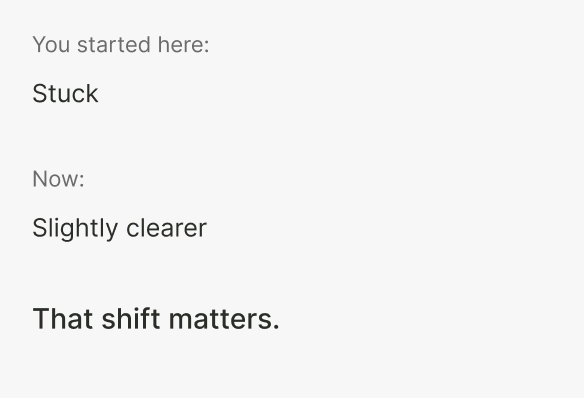
The protocol
Every intervention in Anchor: Pause Protocol, Spiral Reset, Momentum Builder, Numbness Reset — runs through the same four-stage pattern underneath.
01 — Recognition
Identify the emotional state without requiring self-diagnosis.
02 — Regulation
Interrupt the pattern before asking anything else of the user.
03 — Redirection
Convert regulation into one small, concrete action.
04 — Agency
Confirm the shift and hand control back to the user.
Identify the emotional state without requiring self-diagnosis.
02 — Regulation
Interrupt the pattern before asking anything else of the user.
03 — Redirection
Convert regulation into one small, concrete action.
04 — Agency
Confirm the shift and hand control back to the user.
What follows is one protocol, Spiral Reset, walked through in full.
THE product
Flagship Flow
The prototype demonstrates the Entry and Stabilization flows: the highest-friction moments in the system.
Key Design Decisions
Restraint over relief
01 — Mandatory downshift
The nervous system settles before cognitive processing resumes.
The nervous system settles before cognitive processing resumes.
.png)
.png)
.png)
02 — Emotional neutrality
Calm, direct language throughout.
Calm, direct language throughout.
03 — Micro-actions over ambition
Ambitious asks fail when motivation is already low. Tiny ones build momentum.
Ambitious asks fail when motivation is already low. Tiny ones build momentum.
.png)
.png)
.png)
04 — Interrupt before insight
Users are guided out of the loop before being asked to make sense of it.
Users are guided out of the loop before being asked to make sense of it.
Early Validation
Testing the concept
6 participants completed the flow while simulating overwhelm or cognitive looping. The question was directional: does the system create a perceptible shift, and where does it break?
6 participants completed the flow while simulating overwhelm or cognitive looping. The question was directional: does the system create a perceptible shift, and where does it break?
Attention shift confirmed
Every participant reported a noticeable shift in attention during breathing. All completed the flow without guidance.
Every participant reported a noticeable shift in attention during breathing. All completed the flow without guidance.
-> No changes needed. The core intervention does what it was built to do.
Self-Diagnosis unreliable
Participants under-reported their own intensity when self-selecting a state.
Participants under-reported their own intensity when self-selecting a state.
-> Validated the Recognition decision: why it doesn't require self-diagnosis.
Timing was unclear
Breathing rhythm and duration weren't clear on first pass.
Breathing rhythm and duration weren't clear on first pass.
-> Added explicit inhale/exhale cues and tighter visual sync.
Micro-actions untested in the real world.
Simple and realistic in testing, but not validated under real emotional load.
Simple and realistic in testing, but not validated under real emotional load.
-> Left as an open flag for real-world testing. No change yet.
Reflection
Static interfaces assume a stable user. This one doesn't.
Pacing and constraint aren't secondary usability concerns in high-load states. They're the product. The difference between support and friction is timing.
What's unresolved: whether state-aware intervention produces lasting change, or just momentary stabilization. Early signal points to interruption. Sustained behavior change is untested.
What's unresolved: whether state-aware intervention produces lasting change, or just momentary stabilization. Early signal points to interruption. Sustained behavior change is untested.